
Completing Education: Moving into Adulthood
.svg)
Guidance for families with young people aged 16 to 25 who have an Education, Health and Care (EHC) Plan
Download the Easy Read version here
Education
In the UK, young people need to stay in education or training until they are 18, and young people with EHC Plans can stay on longer if they need to (although there is no automatic right to this, even if they have an EHC Plan).
But I thought the EHC Plan went up to 25?
It can, if the young person meets the criteria – i.e. they still need additional support to access education and make progress. But for lots of young people the EHC Plans do stop before the age of 25, e.g. if they finish their education, go on to work or university, or transition to adult social care services.
What are the educational options for young people aged 16-25 with an EHC Plan?
Education can include mainstream or specialist college, sixth form, an apprenticeship, traineeship, or part-time education combined with voluntary work or work experience. There are also supported internships – more about these later!
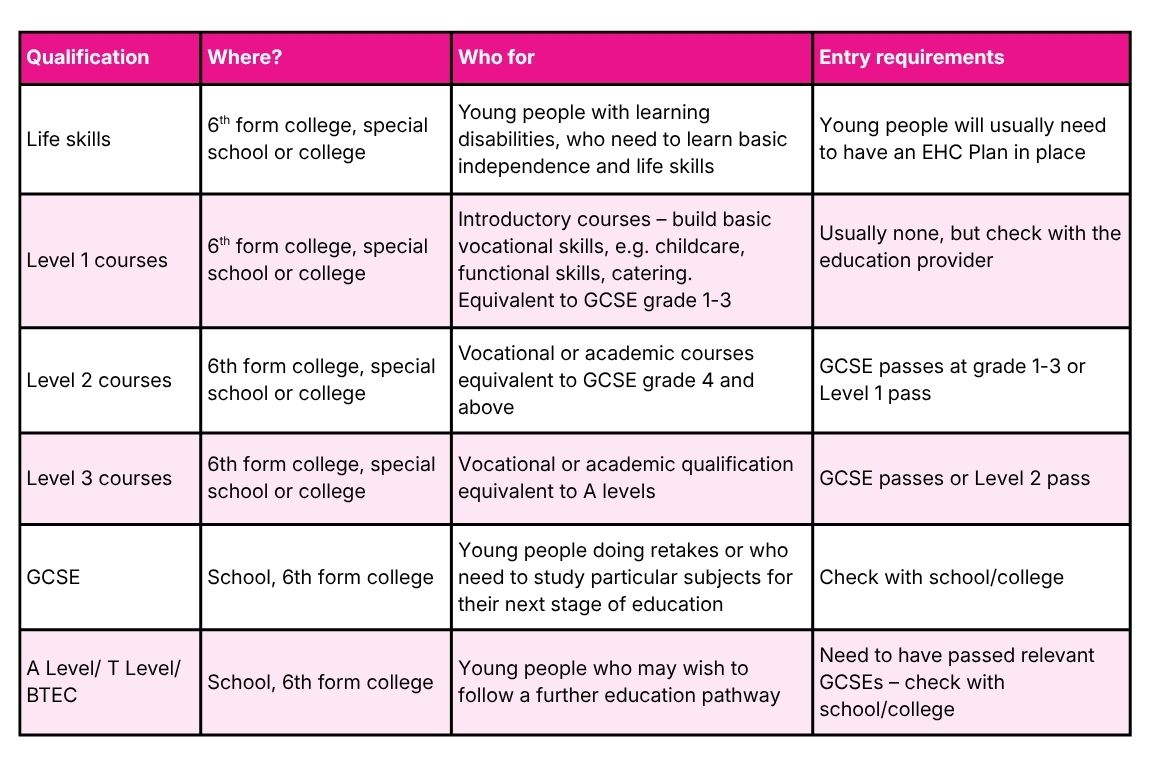
The courses young people with an EHC Plan take will be leading towards their next steps. Some young people will be developing life skills and working on independence. Other young people may be taking apprenticeships or pre-apprenticeships.
Others will be working on qualifications – these can be at level 1, 2 or 3. Or they may be moving up through these levels, or taking BTEC,GCSE or T or A level courses.
Still others may need individual or bespoke provision.
What is the maths and English requirement?
Young people in education, whether they have an EHC Plan or not, have to carry on studying maths and English at college, until they achieve a level 2 in these subjects (equivalent to grade 4 GCSE)
Some young people will not be able to achieve Level 2 –however, they are still usually required to continue to study maths and Englishwhile they are in education.
Annual Reviews
Annual reviews are even more important post 16. The purpose of the Annual Review is to review the young person’s progress towards the “outcomes” in section E of their EHC Plan. The school or college will usually organise the annual review, but for young people not in education, the Local Authority should make sure that an annual review is held.
Questions to consider at annual review:
- Is the young person making progress? What support is in place?
- Are the outcomes appropriate and aligned to the young person's aspirations?
- Is the support right?
- What should happen next for the young person, i.e. will they continue their course, move to the next stage, move on from education?
- Does the young person still need their EHC Plan?
The sixth form years go quickly. Make the most of the Annual Review to discuss how the EHC Plan is working to support your young person. Are they enjoying their course and making progress? What support do they need going forward to next year? How is their developing independence? What are their plans, and what options are available to them?
The young person’s voice and say in their own education and what they want to do next is really important, (and their legal right) so please encourage them to attend their annual review and participate as meaningfully as they can.
Once a young person is 16, their views at annual review will carry more weight than their parents’ (provided they have “mental capacity” i.e. the ability to make their own decisions) The charity MENCAP has a useful guide to mental capacity law here: https://www.mencap.org.uk/advice-and-support/mental-capacity-act
What about young people not attending a school or college?
Some young people with EHC Plans find themselves ‘NEET’ – not in education, employment or training. Maybe they couldn’t find an appropriate course, or they might have health needs preventing them from attending further education. These young people are still entitled to education and support, as set out in their EHC Plan.
Liaise with your case worker to find out what the options are. Your young person should still have their annual review, even if they are not attending an education setting – the Haringey SEND team should organise this for Haringey residents (or your home Local Authority if you live outside of Haringey)
What happens when my young person finishes 6th form education
Discussion about the different options for next steps should be discussed at the Annual Review. This should start in Year 9 when they are 14 and continue to be a key topic on the annual review each year.
If they are attending a school, their placement will usually finish at the end of Year 13 or sometimes Year 14 (when your young person is 18 or 19 years old), but 6th form colleges often continue offering courses to young people aged 19-25.
Many young people with an EHC Plan continue their education beyond the age of 19. The law is designed to allow some young people with SEND longer to complete their education, if they need it.
But - there is no automatic right to continue in education, even though the young person has an EHC Plan. The EHC Plan must continue if the young person still needs the provision in section F of the plan, to help them make progress towards their outcomes (the description on the EHC Plan of what they should be achieving).
The outcomes are different for each individual young person. Whether they carry on to the next year or do something else should be discussed at the annual review. Your views and your young person’s views are a very important part of this discussion.
Educational options for young people at 18-19 years old might include:
- Further Study, such as completing an existing course, moving from a level 1 to a level 2course, or further developing life and independent living skills.
- University – some young people with an EHCP do progress to university. (Once a young person goes to university, the university becomes responsible for providing the support they need, and their EHC Plan will be ceased.)There’s info about how to apply for this support here: Applying for Disabled Students’ Allowance (DSA) | Disability Rights UK
Other options
- A supported internship or pre-supported internship: this is a combination of work and study, usually lasting around a year. It is designed as a pathway into work, and if the young person transitions into paid employment at the end of their supported internship, their EHC plan will be ceased. There are options available inside Haringey and also out of the borough. Young people on a supported internship don’t get paid. Their place and support are funded through their EHC plan. More information here: Supported internships | Haringey Council
- Apprenticeships: Employers can receive additional funding if a young person with an EHC Plan takes up an apprenticeship. The young person will be paid while on the apprenticeship, so once they get started, their EHC Plan will be ceased.
More information here: https://works.haringey.gov.uk/Web%20Forms/WebUser/PortalPage.aspx?Page=apprenticeships
It's worth thinking carefully with your young person about their next steps. Will they stay on their current course? What is it leading to next? Do they need a “bridge” into work, like a supported internship?
Discuss with the setting and talk to other parents. Visit possible provision with your young person to understand what is on offer.
These local organisations may also be able to help:
- Haringey Works: Help young people with writing their CV and applying for jobs: https://works.haringey.gov.uk/Default.aspx
- 16-19 Bursaries: You may be able to apply fora bursary (additional funding to help your young person cover their living expenses while at college.) Check each sixth form and colleges for application process in September each year with evidence of Universal Credit and sometimes other evidence.
- More info here: https://www.gov.uk/1619-bursary-fund
- And here: https://haringey.gov.uk/schools-learning/financial-support-education
Ceasing the EHC Plan
At your young person’s annual review, there may be a discussion about ceasing the EHC Plan. Or you may receive a letter through the post.
A local authority may cease to maintain an EHC plan for a child or young person only if one of these two legal tests apply:
(a) the authority is no longer responsible for the child or young person, or
(b) the authority determines that it is no longer necessary for the plan to be maintained.
Some examples of situations where the local authority may cease to maintain the plan are listed below
- The young person goes to university, or starts work
- The young person turns 25 years old
- The young person has achieved their educational outcomes (this has to be discussed and evidenced at an Annual Review)
- The young person no longer needs the support of an EHC Plan (this also should come out of the Annual Review)
The IPSEA website has a good description of when the LA can cease an EHC Plan: Ceasing to maintain decisions – when they can be made and what it means
Parents and young people have the right to appeal a local authority's decision to end an EHC plan. Contact Haringey SENDIASS if you would like to discuss this. SENDIASS -Markfield
As well as education, you and your young person may need to start thinking about health and social care provision. Education can continue for your young person once they turn 18, if they are learning and making progress. But children’s health and social care services will stop when your young person is 18.
Some young people will continue to need services from adult social care and/or adult health services. This can be discussed at their annual review, and social workers or health professionals can be invited to these meetings or asked to produce a report (if they have been working with your young person
Health and Social Care provision – changes at 18 years old
Health needs
Most young people who have ongoing health needs will be discharged from children’s services and transition to adult’s health services when they are 18years old.
This is different for everyone as it depends on which, if any, specialists you already see and where you would like to be seen. For example, some young people will need to be referred to an adult diabetes specialist, and they may prefer to go to the hospital which is easiest to get to.
Your young person’s GP will continue to hold your medical record and be a central point for managing your health needs.
GPs now offer a review for young people with learning disability over the age of 14 years and occurs every year. This is a health check-up and includes monitoring basic health measurements such as weight, blood pressure etc, but is also an opportunity to review your general health and provide health advice.
There is good evidence to show that this improves the health outcomes for young people who take up this offer.
It is also a good opportunity to establish a relationship with your local medical centre and for them to get to know and understand your young person’s needs as they move towards adulthood. This is important because after the age of 18 years, it is likely that their GP will, in most cases, be the main doctor you see.
You can contact the GP to arrange this. Think of this as a “Birthday Check” and it is then a good way to remember it.
Useful links, contacts and information about health care for over 18s
Continuing health care explained: https://nclhealthandcare.org.uk/keeping-well/continuing-healthcare-chc/
More information about how your young person can be assessed for continuing health care, and eligibility: https://www.nhs.uk/social-care-and-support/money-work-and-benefits/nhs-continuing-healthcare/
Contact details for Haringey’s continuing health care team:
Haringey Continuing Health Care (CHC) Team
Email: whh-tr.continuingcare1@nhs.net
Tel: 020 3198 9743
Working Hours: Monday – Friday 09:00 – 17:00 (excluding bank holidays)
Mental Capacity
When your young person reaches 16 years of age, they are covered by the Mental Capacity Act.
This means that they are considered capable of making decisions for themselves, including health-related decisions, such as giving consent for examinations, treatments, and tests.
If your young person is aged between 16 and 18 you will only be able to make these decisions for them if:
- they lack the mental capacity to do so, and
- you have Parental Responsibility for them.
If they have the mental capacity to make these decisions, you– their parent/carer - may not be able to make health-related decisions on their behalf
After their 18th birthday, even if you had Parental Responsibility, you will not be able to make health-related decisions for them, unless you have been appointed as a Deputy by the Court of Protection.
This is an easy-read guide to the Mental Capacity Act: Mental Capacity Act 2005: An easy read guide
There’s info here about how to become a deputy: Deputies: make decisions for someone who lacks capacity: Overview - GOV.UK
Mental Health – support from voluntary organisations
Mind in Haringey including Safe Haven Crisis Hub
Mind in Haringey provides information, advice and support to people affected by mental health problems, primarily in Haringey. They work to prevent mental health problems, promote mental wellbeing and ensure those experiencing a mental health problem are respected and included in the local community.
This service is primarily for: adults aged over 18 who are living in Haringey and/or has a Haringey GP.
Their vision is to help enable and support positive mental wellbeing, to improve lives.
There is a referral process for all services at Mind in Haringey as they do not offer a drop-in service. Please look for the referral form on each page to complete and submit online.
- https://www.mindinharingey.org.uk/our-services/
- https://www.mindinharingey.org.uk/our-services/safe-haven-crisis-hub/
- https://haringey.gov.uk/children-young-people-families/childrens-social-care/transitions/safe-haven-crisis-hub-mind-haringey
- https://www.mind.org.uk/for-young-people/information-for-parents/
- https://www.mindinharingey.org.uk/our-services/haringey-wellbeing-network/advocacy-and-social-prescribing/
Mental Health Crisis Breathing Space: https://www.wearegroup.com/mhcbs
Support for young people with life-limiting illnesses
North London Hospice
North London Hospice provides free palliative and end of life care to those in North London facing a life-limiting illness. We are also here to provide support to their families, friends and carers: https://northlondonhospice.org/
Social Care Needs
Some young people over the age of 18 and who have complex needs may move out of education and into adult social care provision. This needs to be done through consultation with you and your young person.
In Haringey, all young people who have an EHC plan and are already known to Disabled Children’s Social Care should receive an assessment when they are 17, to see whether and what services they may be entitled to when they turn 18. This can include things like care support in the home, access to social activities, and for some young people, supported housing. In Haringey these assessments are carried out by the Steps to Adulthood service (Transitions) | Haringey Council
Young people with higher needs may stop their education before the age of 25. This can happen If education has come to an end for young people, either because they no longer wish to engage in education or because they are not making progress and learning. Some young people may meet the criteria for social care support. It will depend on their level of disability, and will be determined by a Care Act Assessment.
It’s really important for parents and young people to understand what this means, especially if the EHC Plan is being ceased. What support will be available, and what will the young person be doing?
For young people who have been assessed with more complex and long-term needs, Adult Social Care may provide a range of support which could include things like
- Support to access daytime activities and social and leisure opportunities
- Supported housing
- Personal assistance (this is sometimes funded through Direct Payments)
As parents/carers of young people with complex disabilities, you yourself may also be eligible for a Care Act assessment, to see if you have support needs. You can self-refer for a Care Act assessment for your young person once they are 17, and/or yourself.
Useful links – Care Act assessments:
- https://haringey.gov.uk/adult-social-care/contact-adult-social-care
- https://haringey.gov.uk/adult-social-care/adult-social-care-assessments
- https://www.scie.org.uk/assessment-and-eligibility/
Volunteering opportunities for young people
St Johns Ambulance Youth programmes
They have fantastic programmes so young people of all ages can get involved.
They offer a range of popular youth programmes for young people aged 5-25. This essential service is only possible with the support of their dedicated volunteers. They help young people to learn first aid and other important life skills in a fun, inclusive, and engaging environment. As a volunteer, you can get involved with Badgers (ages 5-10), Cadets (ages 11-17),or become a Duke of Edinburgh's Award Leader.
Volunteering with their Youth Team is an incredibly varied and rewarding role. One day you could be designing and delivering a game to teach first aid, the next you could be supporting a youth camp-out. No two days are the same!
https://www.sja.org.uk/get-involved/young-people/
https://www.sja.org.uk/get-involved/volunteer-opportunities/volunteer-opportunity-search/
British Red Cross
Looking for work experience, student placements or Duke of Edinburgh volunteering? Take a look at their opportunities for young people page to see all of the youth volunteering roles on offer for people aged 15-25 years old: https://www.redcross.org.uk/get-involved/opportunities-for-young-people


More information
Find more info about preparing your young person for adulthood on Haringey’s website here: Haringey preparing for adulthood pathway guide - June 2023
The organisation IPSEA have clear advice about the law when it comes to Local Authorities ceasing to maintain EHC Plans: Ceasing to maintain decisions – when they can be made and what it means
SENDIASS are here to help you understand the system, your rights and your young person’s rights: https://markfield.org.uk/sendiass/
Useful links
- Sense
- Independent Provider of Special Education Advice (IPSEA)
- Council for Disabled Children
Good luck!!
Huge thanks to all the parents, carers and practitioners who helped us pull this information together.


SEND Power in Haringey is hosted by The Bridge Renewal Trust, a company limited by guarantee registered in England and Wales under number 06949568 and registered as a Charity number 1131941. Registered office Laurels Healthy Living Centre, 256 St Ann's Road, London N15 5AZ
